Heli Simola, Bank of Finland Institute for Emerging Economies (BOFIT)
Since Russia's full-scale invasion of Ukraine, tracking and analyzing trends in the Russian economy has become more challenging. There is greater uncertainty surrounding Russian statistics, making them harder to interpret and requiring extra scrutiny. This situation is influenced both by deliberate decisions made by Russian officials and by structural changes within Russia's economy brought about by the war.
Data access is decreasing
Russian authorities have restricted or discontinued the publication of numerous statistical series essential for economic analysis. As a result, publicly available information on, for example, foreign trade, foreign investment, and federal government expenditure has diminished. The release of statistical data regarding e.g. oil production and demographic trends has been fully suspended.
The absence of comprehensive statistical data complicates assessments of impacts of the war and sanctions on the Russian economy. Analysts are required to identify various alternative sources and indicators to estimate the missing information, such as mirror statistics (e.g. partner country information on foreign trade) or estimates of international organizations and experts (e.g., IEA statistics for Russian oil output and SIPRI or Janis Kluge’s analyses for Russian military spending).
Several studies have already utilized partner-country trade statistics to evaluate Russia’s recent trade patterns. Findings indicate that Russian imports of many sanctioned goods have significantly decreased in recent years, despite some rerouting through intermediary countries (Emlinger & Lefebvre, 2025; Korhonen & Simola, 2024). Studies also suggest that even when Russia manages to acquire goods subject to sanctions, it often incurs substantially higher costs (Corsetti et al., 2026; Korhonen & Simola, 2025). These developments illustrate how sanctions have complicated Russia’s manufacturing of military equipment in particular.
Data interpretation is now more important
An additional factor increasing uncertainty around Russian economic statistics is the challenge of interpreting them under current circumstances. Russia’s economy has been transitioning towards a war-oriented structure in recent years, altering the composition of the economy. Military expenditure as a share of Russia’s GDP is estimated to have risen from about 4 % in the years preceding the full-scale invasion to 7.5 % in 2025 (SIPRI, 2026). As a consequence, military activities are playing an increasingly significant role across various sectors.
Official statistics indicate robust GDP growth in Russia, particularly in 2023–2024. However, even a modest breakdown of the data reveals that this growth has largely originated from industries closely connected to Russia’s military operations, while other sectors have exhibited much weaker performance. Detailed Rosstat industrial production statistics show that the output of numerous industrial products, like washing machines and grain harvesters, has markedly declined over recent years. This has been caused by reallocation and crowding out of resources in favor of the military-connected industries and complications arising from sanctions (Simola, 2026).
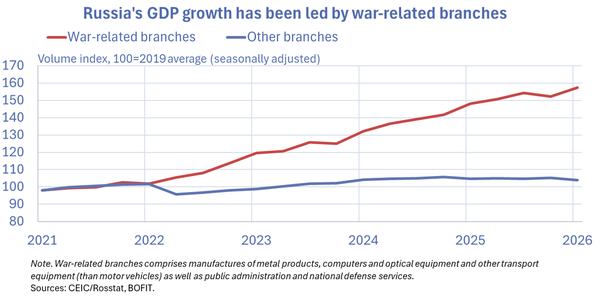
For example, when government money is used to refurbish an old Soviet tank taken from the storage, which is then destroyed in combat, it registers as GDP growth for Russia (following the compilation principles of national accounts). Such growth does, however, little to improve ordinary Russians’ welfare or the country’s future economic prospects (Korhonen et al., 2025). Russian GDP figures now increasingly reflect different underlying realities compared to previous years.
Data quality has come under scrutiny
There is also uncertainty related to the quality of the official Russian statistics. Many Russian statistical measures have faced criticism for years because of frequent changes in methodology and a lack of transparency in how data is compiled—for example, Rosstat's household revenue indicators. Some research indicates that Russian officials have manipulated COVID mortality statistics during the pandemic (Lamberova & Sonin, 2022). Some observers have also raised suspicions that Russia may have begun manipulating economic statistics in recent years to portray economic situation as better than it actually is (Wiśniewska, 2023).
Manipulating economic statistics would demand significant coordination and considerable effort from officials, which may not be feasible in Russia’s current environment (Libman & Whitmore, 2026). At least so far it has been difficult to detect any major breaks in commonly used economic statistical series that would coincide with the outbreak of the war (Simola, 2024). Different sets of economic data from various sources have shown consistent patterns and indicated comparable trends (Simola, 2025). This suggests that in general the quality of Russian economic statistics has in recent years been as good or as bad as it was before the full-scale invasion.
However, there may be more pressure on statistical officials to manipulate statistics as economic conditions worsen. Russia’s growth has stalled and the official preliminary information suggests that in January-March 2026 GDP even declined by 0.2 % y/y. In the future, it is increasingly important to review diverse economic indicators from multiple sources to gain a comprehensive view on the state of the Russian economy.
Despite statistical uncertainty, conclusions from statistics are clear
In any case, all statistical information available points to clear conclusions. First, the war and sanctions are taking their toll on the Russian economy. Russia’s economic and financial situation is gradually deteriorating. Russia’s longer term growth potential is eroding. Second, if external pressure on Russia were intensified, it would lead to additional costs for Russia and make it more difficult for the country to sustain its war against Ukraine.
***
Dr. Heli Simola is a senior economist at the Bank of Finland Institute for Emerging Economies (BOFIT), specializing in analysis and research of Russian economy and economic policy.